Maintaining peak operational efficiency in industrial power transmission often hinges on a single, frequently overlooked component: the coupling. When misalignment occurs between a motor and a driven load, the resulting vibration and wear can lead to catastrophic bearing failure and unplanned downtime.
The shift toward lubrication-free components is redefining how engineers approach maintenance cycles. By reducing the reliance on grease and oil, facilities can eliminate contamination risks and significantly lower long-term operational expenditures.
Selecting the right shaft coupling Factory is no longer just about finding a part that fits, but about integrating a solution that optimizes energy consumption and extends the lifecycle of the entire drive train.

The Evolution of Maintenance-Free Transmission

Traditional coupling systems often relied on heavy lubrication to prevent metal-on-metal friction, which created a cycle of constant maintenance and the risk of grease leakage. In precision industries, this contamination can be unacceptable, especially in textile or food processing.
Modern engineering has shifted toward self-lubricating materials, such as high-strength nylon, to bridge the gap between durability and cleanliness. This transition allows for a "fit-and-forget" approach, where the coupling maintains performance across thousands of cycles without human intervention.
Engineering Logic of Nylon Sleeve Design
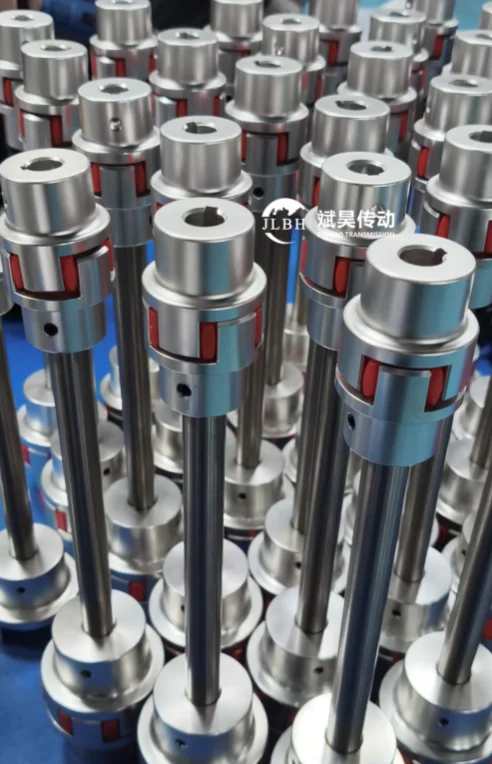
The technical core of a nylon sleeve coupling, such as the TGL series, lies in its hybrid material composition. By pairing 45# forged steel for the external hubs with a high-strength nylon internal sleeve, the design achieves a synergy of structural rigidity and dampening capacity.
A critical feature is the drum-shaped tooth profile. Unlike flat gear teeth, the curved profile allows for better distribution of torque and provides a natural mechanism for compensating angular and radial deviations. This prevents the rigid transfer of shock loads directly into the motor bearings.
Furthermore, the axial plug-in structure simplifies the installation process. Instead of complex alignments that require extensive dismantling, the insertable design allows for rapid assembly, which significantly reduces the labor cost associated with initial setup and periodic replacement.
Balancing Weight and Torque Capacity
In high-speed industrial fans and pumps, the mass of the rotating components directly affects the inertia of the system. Every additional kilogram of weight increases the starting torque required from the motor, leading to higher energy spikes during ramp-up.
Replacing all-metal couplings with composite-hybrid designs can reduce total component weight by up to 40%, directly lowering motor starting loads and enhancing overall energy efficiency by 5-8%.
Despite the weight reduction, the TGL series maintains a robust working torque range between 200 and 5,000 Nm. This ensures that the transition to lightweight materials does not compromise the ability to handle the rigorous demands of heavy-duty light industry and textile machinery.
Energy Efficiency Metrics in Drive Trains
The impact of inertia on energy consumption is most evident in applications characterized by frequent start-stop cycles. A moment of inertia ≤ 0.5 kg·m² minimizes the energy lost to accelerating the coupling itself, allowing more power to be directed toward the actual load.
When evaluating the total cost of ownership (TCO), the reduction in energy costs and the elimination of lubrication labor create a compounding financial benefit over the component's 100,000-cycle lifespan.
Figure 2. Relative Performance Index: Hybrid vs Traditional Couplings
Application Scenarios in Corrosive Environments
Chemical processing plants and marine settings present a hostile environment for standard metal couplings, where acids, alkalis, and moisture accelerate oxidation and wear. The inherent properties of high-strength nylon provide a natural defense against these corrosive agents, extending the operational life of the transmission system.
In these settings, the TGL series is often selected not only for its material resistance but also for its noise-dampening capabilities. With operating noise levels maintained below 65 dB, it is an ideal solution for environments where acoustic pollution must be minimized for safety or regulatory compliance.
Trends in Low-Inertia Component Integration
The industry is moving toward "Intelligent Transmission," where the physical properties of the coupling are designed to complement the control logic of the motor drive. Low-inertia couplings allow for faster response times and more precise acceleration curves.
As manufacturers prioritize ESG (Environmental, Social, and Governance) goals, the reduction of petrochemical lubricants in the factory floor becomes a priority. The adoption of nylon-sleeve technology aligns with these green manufacturing initiatives.
Future developments are likely to focus on further increasing the torque density of composite materials, allowing smaller couplings to handle larger loads without sacrificing the vibration-dampening benefits of nylon.
Selection Framework: Metal vs. Composite
Choosing between a traditional all-metal gear coupling and a nylon sleeve coupling requires a trade-off analysis. While all-metal systems may offer absolute maximum torque for extreme heavy-industry applications, they bring higher maintenance costs and noise levels.
For most light industrial, textile, and pump applications, the hybrid approach offers a superior balance. The ability to compensate for ±1.5° angular deviation protects expensive motor bearings from premature failure, a benefit that often outweighs the raw torque advantage of metal.
The following framework summarizes the relative suitability based on common industrial requirements.
| Evaluation Factor | Traditional Metal | TGL Nylon Sleeve | Selection Driver |
|---|---|---|---|
| Maintenance Requirement | High (Regular Grease) | Ultra-Low (Lubrication-Free) | OpEx Reduction |
| Energy Consumption | Standard Baseline | 5-8% Reduction | Sustainability |
| Acoustic Emission | High (Metal-on-Metal) | Low (≤ 65 dB) | Noise Regulations |
| Installation Time | Complex Alignment | Rapid Axial Plug-in | Labor Efficiency |
| Environmental Resistance | Prone to Oxidation | High Corrosion Resistance | Chemical/Marine Use |
| Dynamic Response | Higher Inertia | Low Inertia (≤0.5kg·m²) | Start-Stop Frequency |
Questions & Answers
The primary advantages include a 40% reduction in overall weight, which lowers the motor's starting load and reduces energy consumption by 5-8%. Additionally, the elimination of lubrication removes the risk of grease contamination and lowers long-term maintenance costs by more than 30%.
The TGL coupling utilizes an optimized drum-shaped tooth profile that allows it to automatically compensate for angular deviations up to ±1.5° and radial deviations up to ±0.5mm. This flexibility protects critical bearings from premature wear caused by misalignment.
Yes. The high-strength nylon material used in the sleeve is inherently resistant to acids, alkalis, and moisture. This makes it far more durable than standard steel couplings in corrosive environments, ensuring a longer service life in chemical processing plants.
In typical industrial conditions, such as textile machinery or lubricating pumps, the TGL series is engineered to withstand up to 100,000 start-stop cycles. The self-lubricating properties of the nylon surface effectively eliminate metal micro-motion wear.
A lower moment of inertia (≤0.5kg·m²) reduces the rotational mass that the motor must accelerate. This leads to smoother acceleration, reduced electrical current spikes during startup, and a measurable decrease in overall energy consumption.
It is most beneficial for light industry, textile machinery, chemical processing, and any application involving industrial fans or pumps where quiet operation, zero lubrication, and minimal maintenance are critical for operational efficiency.
Final Thoughts
The transition from traditional all-metal couplings to hybrid nylon-sleeve designs represents a strategic shift toward efficiency and sustainability in industrial transmission. By addressing the root causes of downtime—misalignment and lubrication failure—these components allow for a more resilient and cost-effective drive train.
Ultimately, the value of a precision coupling lies in its ability to disappear into the background of the operation, providing seamless power transmission while minimizing the need for human intervention. For enterprises aiming to reduce O&M costs, the investment in low-inertia, maintenance-free technology is a clear path toward optimized machinery performance.