


NM Cast Iron Elastic Coupling China Factory and Reliable Suppliers

The NM Cast Iron Elastic Coupling is a high-performance transmission solution specifically engineered for medium and small torque applications. By integrating precision-engineered high-strength cast iron hubs with a specialized annular rubber elastic pad, this coupling delivers superior buffering and vibration damping, significantly extending the operational lifespan of critical machinery such as motors, reducers, water pumps, and industrial fans.
Designed for versatility and extreme durability, the NM series excels in compensating for angular and radial misalignments while absorbing sudden impact loads to minimize operational noise. Its cost-effective architectural design and simplified maintenance process make it the premier choice for industrial environments requiring reliable power transmission in temperatures reaching up to 80°C.
Detailed Parameters
| Main Material | High-Strength Cast Iron | Elastic Element | Annular Rubber Pad |
|---|---|---|---|
| Angular Deviation | ≤ 1° | Radial Deviation | Approx. 0.5mm |
| Max Working Temp | ≤ 80°C | Torque Capacity | Medium to Small |
| Compensation | Axial expansion/contraction | Structural Feature | Torsional Rigidity |
| Typical Applications | Fans, Pumps, Mixers | Maintenance | Replaceable Rubber Gasket |
Key Advantages
Structural Stability
Constructed from high-strength cast iron to ensure maximum torsional rigidity and structural integrity during heavy operation.
Vibration Reduction
The embedded rubber pad effectively absorbs impact loads and reduces noise, protecting motors from mechanical fatigue.
Precision Compensation
Capable of compensating for angular deviations up to 1° and radial offsets of 0.5mm for seamless shaft alignment.
Cost-Efficiency
Combines economical cast iron materials with a simple design to provide a high return on investment for industrial users.
Easy Maintenance
Rubber gaskets can be replaced quickly by removing bolts without dismantling the entire equipment assembly.
Broad Applicability
Perfectly suited for conveyor belts, stirring equipment, and water pumps operating in standard temperature environments.
Product Gallery


Management Platforms
Inventory Control
Real-time tracking of coupling stock levels to ensure rapid delivery for urgent replacements.
Quality Assurance
Rigorous inspection of cast iron tensile strength and rubber elasticity before shipping.
Maintenance Alerts
Scheduled reminders for rubber pad inspections to prevent unexpected downtime.
Technical Support
Expert guidance on selecting the correct NM size for your specific torque requirements.
Logistics Tracking
Integrated shipping platforms for global delivery of heavy-duty coupling components.
Lifecycle Management
Analysis of wear patterns to optimize the replacement cycle of elastic elements.
Investment Return Comparison
| Comparison Feature | NM Elastic Coupling | Rigid Coupling |
|---|---|---|
| Vibration Damping | Excellent (Rubber Pad) | Poor (No Buffer) |
| Installation Ease | High (Flexible) | Low (Requires Precision) |
| Equipment Wear | Reduced (Shock Absorption) | Higher (Direct Impact) |
| Maintenance Cost | Low (Modular Gaskets) | Moderate (Full Alignment) |
| System Lifespan | Extended | Standard |
Frequently Asked Questions
The rubber pad serves as the core elastic element, providing critical buffering to absorb impact vibrations and compensating for minor axial, radial, and angular misalignments.
The long-term working temperature should not exceed 80°C. If your environment exceeds this, the rubber will age prematurely and require more frequent replacement.
The NM series is specifically designed for medium and small torque transmissions. For extreme high-torque needs, we recommend exploring our Gear or Diaphragm coupling series.
Maintenance is simple: regularly inspect the rubber pad for wear or cracks. Replacement only requires removing the bolts to swap the gasket without moving the main machinery.
It is widely used in industrial fans, water pumps, mixers, and conveyor belt systems where vibration reduction is essential for equipment safety.
It can compensate for angular deviations up to 1° and radial (parallel) offsets of approximately 0.5mm, as well as small amounts of axial expansion.
Looking for a High-Durability Coupling Solution?
Contact Us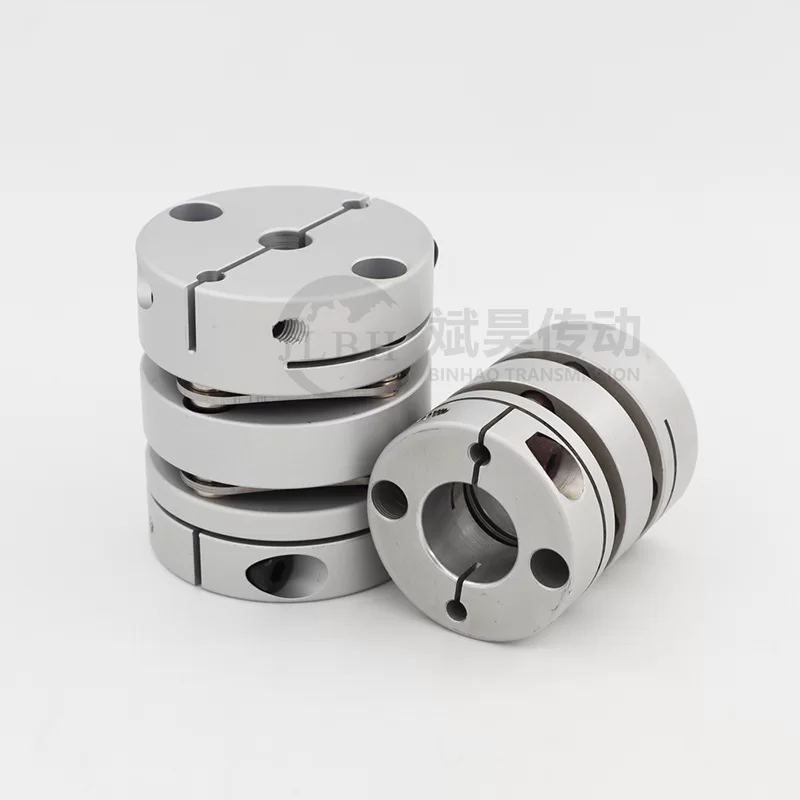


Precision in power transmission is the cornerstone of high-performance automation. When dealing with servo systems, CNC equipment, or 3D printing modules, the slightest rotational clearance can lead to significant positioning errors and accelerated component wear. The aluminum alloy double diaphragm coupling is engineered specifically to eliminate this backlash while compensating for critical alignment deviations. By leveraging the elastic deformation of stainless steel diaphragms, this component ensures a rigid yet flexible torque transfer that protects sensitive encoders and motors from axial and radial stress. For procurement managers and system engineers, selecting a reliable flexible coupling Factory means balancing torsional rigidity with lightweight construction.


